
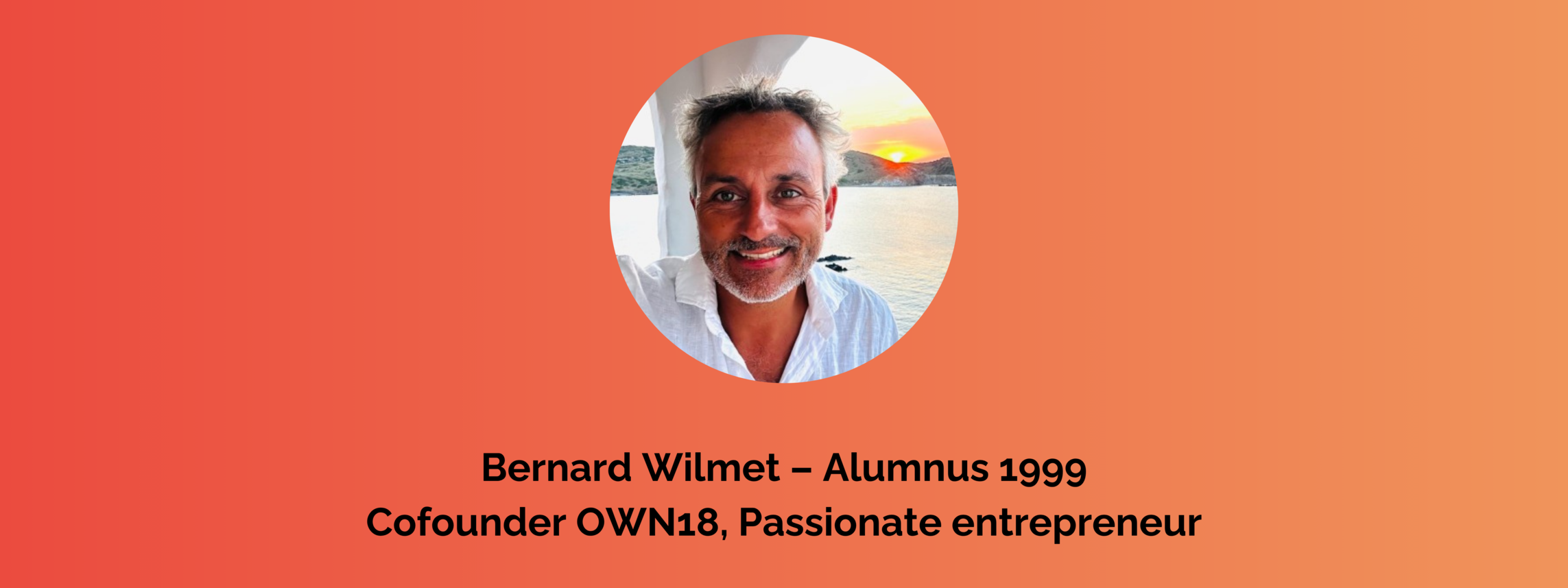
Meet Bernard - March 2026.
What memories do you keep from your time at Solvay Schools? Can you share two?
B: I have to admit I probably wasn’t the most diligent student when it came to attending classes, but that doesn’t stop me from having great memories of my time at Solvay. I was also very involved in student life - I served as president of a student circle, which was a formative experience and, in a way, my first taste of entrepreneurship.
If I had to highlight two aspects of my time there, the first would be the intellectual intensity. Solvay brings together ambitious, serious students who challenge each other and push one another to think more clearly and structure their ideas. Even though the programme is quite generalist, the level of expectation and the collective ambition really leave a mark.
The second is the strong connection with the real economic world. We had professors who came directly from the business environment, sometimes very well-known figures. They shared real-life situations, practical examples and their professional experiences. That exposure to the realities of business was extremely inspiring.
How did your years at Solvay Schools shape the way you work in the real estate sector?
B: For me, Solvay mainly provided analytical rigour and a structured way of thinking, rather than a specific sector focus.
In fact, real estate was not my initial plan. After graduating, I followed a fairly classic path and started in management consulting at Arthur Andersen. But quite quickly, I moved towards entrepreneurship. I launched my first company in 2002, a second in 2003, and since then I’ve never really stopped - I think I’m now close to my fifteenth venture.
Real estate gradually entered the picture, particularly when I moved into the hotel business around 2008 with a partner. Over nearly twenty years, we bought, developed and operated several hotels in Brussels.
Our partnership worked well because we were complementary: he came from a hotel management background and was very operational, while I brought a more analytical and strategic approach, which was very much shaped by my Solvay training. That combination proved to be very effective.
Even today, I try to maintain that balance: a solid analytical approach combined with an entrepreneurial mindset, where you test ideas, learn from experience and move forward pragmatically.
What from your experience at Solvay prepared you the most for the challenges of today’s real estate sector?
B: What helps me the most today is the ability to think in systems.
Real estate sits at the intersection of many different dimensions: finance, risk management, economics, legal frameworks, and of course the human expectations of users and clients.
The training at Solvay encourages you to understand how these systems interact. That broader perspective makes it easier to navigate between these different dimensions and take decisions with a more global view.
It’s also this type of thinking that led me to explore new real estate models, such as fractional ownership or shared property models, which combine economic considerations with new ways for people to use and access property.
What feelings does the Alumni community inspire in you today? Does it play a role in your professional journey?
B: For me, the Alumni community represents above all trust and continuity.
I’ve always been quite involved in the network. Shortly after graduating, I even joined the Alumni committee and launched the Solvay regatta. I’ve always enjoyed contributing to the life of the community.
The network does play a role professionally. Saying you studied at Solvay still carries weight, particularly in certain professional contexts such as discussions with investors or banks.
Beyond that, it’s also a network of capable and approachable people. You know you can easily reach out, exchange ideas, or get feedback from people who share a similar background.
I also find it inspiring to follow the paths of other alumni. You realise how present the Solvay network is across many sectors and in key positions. It creates a strong sense of belonging to a wider professional community where exchanges remain open and natural.
Discover more about Own 18 here!