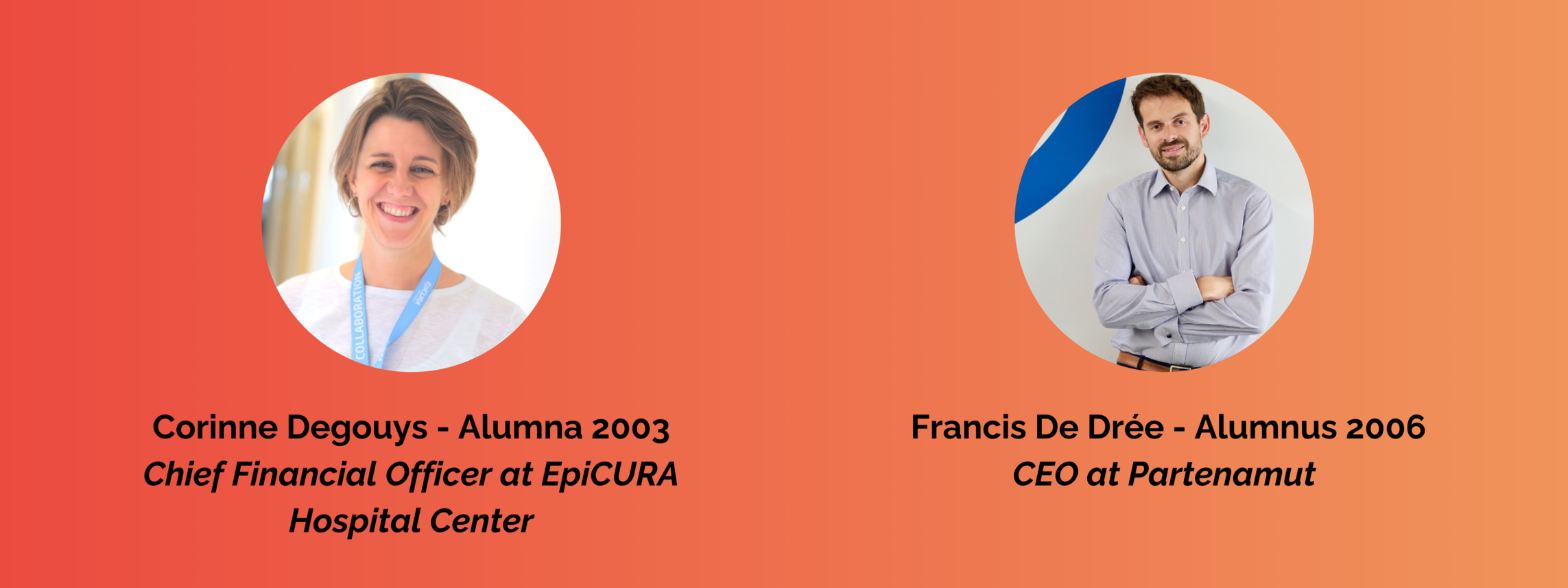
C: Above all, I retain memories tied to hard work and personal commitment. Those were five years during which I focused intensely on my studies. I developed a genuine passion for certain subjects such as management, accounting, and marketing, which were among my favorites. More broadly, I have always been very interested in many different fields, and Solvay Business Schools nurtured that curiosity.
The second lasting memory is that of the people I met and the friendships I formed. Many of those I met at the time are still part of my network today, to varying degrees of closeness, including some very close friends. Those years also represented a real opening to the world - to the financial and economic world, of course, but also more broadly through experiences such as Erasmus and the many international exchanges.
Being based on the Solbosch campus and not originally from Brussels, I felt as though I was stepping into a new world. Encounters with professors also contributed to this discovery. Looking back, what I remember most is this dual dimension: academic rigor and openness.
F: The first memory that comes to mind is the diversity of the teaching. We had courses covering a wide range of disciplines: sciences, mathematics, management, law, history, social sciences… With hindsight, this richness is valuable in a professional career. It offers a global vision and a solid background that allow one to approach complex issues with openness and perspective. This is undoubtedly the main dimension I retain from the program.
A second significant memory concerns the strategic seminars, notably the one led by Michel Allé, as well as the late Yvan de Beaufort. We took part in a “business game” consisting of developing a network of airline routes in Southeast Asia. The exercise, organized in real time, was fascinating. Beyond its playful aspect, it immersed us in a deeply strategic and concrete reflection. It was a particularly formative experience.
How did your years at Solvay shape the way you work in the healthcare sector?
C: It is important to point out that I did not move directly into the hospital sector after my studies. At the time, one does not necessarily see a hospital as a natural career path for a business engineer.
Even before graduating, I was recruited by Ernst & Young (EY) in a fairly traditional way: I signed a contract during my final year. I worked there for twelve years, mainly in audit, gradually specializing in the non-profit and public-equivalent sectors. This period was decisive, particularly because of the continuous learning it required - an element that remains central to my professional path.
At one point, the logical next step in my career was to become Partner. It was precisely then that I began to reflect on my aspirations. The hospital sector appeared to me as an ideal synthesis of several dimensions: management expertise, technical accounting skills, the logic of a large organization, and the specific nature of the non-profit sector.
It was actually through the Solvay Schools network that I met my future employer, the hospital’s CEO, who was also a graduate of Solvay Schools.
In the hospital environment, complexity is extreme, particularly in terms of financing, which has been made especially challenging by successive legislative changes and Belgian institutional reforms. To navigate it, one must maintain a “meta” perspective - a helicopter view - while also being able to dive into a detailed analysis of figures and mechanisms.
My studies at Solvay Business Schools taught me precisely that: how to move between a broad strategic vision and detailed analysis.
Finally, working in a hospital means addressing very different audiences: administrative staff, doctors, nurses, and care assistants. Adapting one’s language, simplifying complex issues, and demonstrating pedagogy and patience are essential skills. In my view, this ability to engage with a wide range of stakeholders has its roots in the education I received at Solvay Schools.
F: My studies at Solvay Business School gave me ease in very varied subjects. More than the content itself, it is a mindset that I developed there: that of considering no field as foreign or out of reach. Of course, we are not experts in all disciplines, but we learn to engage in dialogue with everyone and to structure our thinking when faced with a complex problem.
In the healthcare sector, this proves particularly valuable. I am obviously not a physician, but this training allows me to open a dialogue with medical professionals, to understand their challenges and to seek, with them, appropriate solutions. It helps to find a common language and to structure exchanges, even in very specialized contexts.
What, in your experience at Solvay Business School, best prepared you for the specific challenges of today’s healthcare sector?
C: After my first years of professional experience, I returned toSolvay Business Schools to complete the Master in Management of Healthcare Institutions (MISS), which usefully complemented my initial education.
That said, what prepared me most was the managerial dimension in the broad sense. From the very beginning of my career, this cross-functional approach to management has guided me. Solvay Schools does not only provide technical knowledge; it fosters a way of thinking, of approaching problems, and of structuring decisions.
Another key element is the network. From the very first day, we are told that we are joining a community that extends far beyond our years of study. Over time, you realize that this is truly the case: the Solvay Business Schools network reactivates at sometimes unexpected moments and creates opportunities for exchange and collaboration.
It is a dimension whose importance is not always fully appreciated during one’s studies, but which takes on its full meaning in professional life.
F: We had the possibility to choose options and to explore less classical paths. This freedom brought me a great deal. For example, I chose diplomacy courses given by Jean-Louis Six, a subject that particularly interested me and still fascinates me today.
In the healthcare sector, where stakeholders are numerous — public authorities, patient associations, medical unions, hospital management, mutual insurance funds — the ability to engage in dialogue, negotiate and build consensus is essential. The courses followed outside the core curriculum gave me valuable keys to understand these dynamics and to carry out, on a daily basis, genuine diplomatic work.
What feeling(s) does the Alumni community inspire in you today? Does it play a role in your professional journey?