
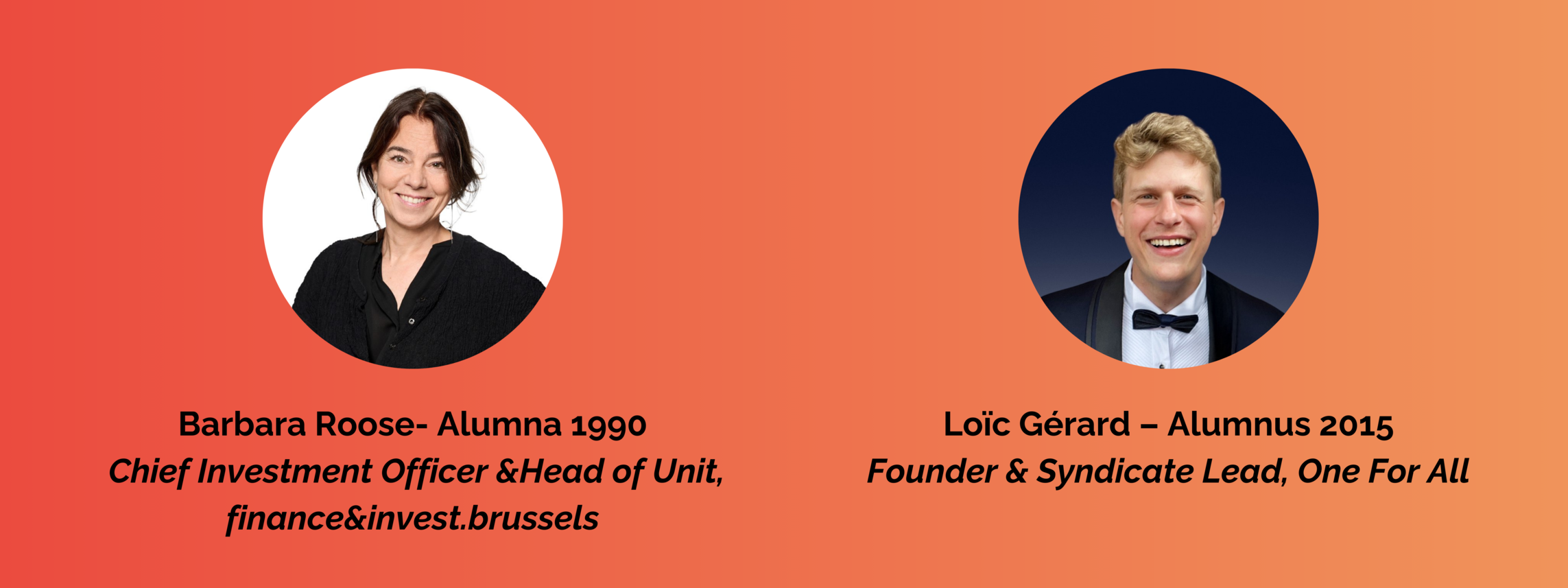
Meet Barbara and Loïc - January 2026.
What has your path been like after your studies?
B: I did not jump immediately into the world of investment. At the time, large companies - the Big Five, regularly came to campus to present their career opportunities. Banks were also very present. The path seemed clearly laid out.
I therefore started my career at PwC (then Coopers & Lybrand), in audit. It was a logical continuation of my studies, almost a natural next step. The firm recruited around one hundred people per year, including about fifteen from Solvay Schools. Many familiar faces - classmates from my year, and even students from the year above (due to the fact that compulsory military service still existed at the time).
I stayed there for almost three years, long enough to complete three audit seasons.
The atmosphere among colleagues from my intake was excellent, but quite quickly I felt that it wasn’t right for me. I had the feeling of always looking backward: account closings, checks, controls. I wanted something more forward-looking, something more useful in the way I personally understood it.
Through a headhunter, an opportunity arose to join a newly created structure within the SRIB, dedicated to what were not yet called startups, but rather “starters.” At that time, banks were beginning to create departments dedicated to young companies, and the Region wanted to launch a specific fund.
That’s how I joined Brustart, which still exists today and has since become a subsidiary of finance&invest.brussels. We were about ten people at the beginning. Today, we are around forty.
L: In 2015, I completed my studies at Solvay ULB, with a degree in business engineering in hand. At 23, I made a decision that would shape the rest of my journey: to move forward on two parallel paths.
On one side, I started my career at ExxonMobil, notably as a trader. I was expatriated to Paris, managed teams, and learned rigor, fast decision-making, and how large organizations operate.
On the other side, I began investing in private companies quite early on - and in a rather unorthodox way. While Solvay teaches diversification, I did exactly the opposite. My very first investment at 23 perfectly illustrates this: I had €25,000 in my bank account… and I invested €20,000 of it into a startup (Entobel) based in Singapore, founded by two Solvay Schools alumni. A risky but deliberate bet.
This first step whetted my appetite. I continued investing in several startups, mainly in the United States and Asia. I learned by doing - sometimes at my own expense - but always with great enthusiasm. Then, at a key moment in my journey, one question became unavoidable:
How could I professionalize my approach to investing in private companies?
That’s when I joined BeAngels - first as a member, then as a coach. There, I structured my approach, refined my analysis, and discovered the power of collective investing.
In the summer of 2024, a new opportunity completely changed the game. I discovered a private American company from Silicon Valley: Groq. Groq develops specialized chips for artificial intelligence. I conducted my due diligence. I was 100% convinced. I wanted to invest.
The problem: Groq was no longer a startup. The minimum ticket was €500,000, with a deadline of barely one month to position ourselves.
Obviously, not having that kind of money sitting in my bank account, I was a bit discouraged. But instead of seeing an obstacle, I chose to see an opportunity.
I told myself: Loïc, along your journey you’ve met many investors - people who believed in you and trust you. So I reached out to my network, explained Groq, shared the vision and my due diligence. I had never raised funds before, and yet it worked. In one month, I raised €1.5 million - enough to invest in Groq under institutional conditions, at a valuation of $3 billion.
In September 2025, we did it again: another €1 million raise, this time at a $7 billion valuation.
Then Christmas 2025 arrived.
That day, I received a notification on my phone that felt unreal: NVIDIA was in the process of acquiring Groq for $20 billion. In a year and a half, we went from a $3 billion valuation to $20 billion. Needless to say, my 70 investors in Groq had plenty to smile about (and I thank them immensely for the trust they placed in me!).
This story, with its ups and downs, is mine. But more importantly, it is the starting point of a more ambitious project. Today, I am building a true investment club with a clear mission: giving access to inaccessible opportunities. Not startups, but late-stage private tech companies - opportunities with an exceptional risk–return–liquidity ratio. Like Groq.
My goal is to grow One For All into the largest investment club in Belgium. I don’t know if we’ll get there, but this is the beginning of an adventure, and you’re more than welcome to join us. I can’t wait to see how far it will take us.
What memories do you keep from your studies at Solvay Schools?
B: I have very fond memories of my studies at Solvay Schools. It’s difficult to name only two, as experiences accumulate over time, but some remain particularly striking.
The first, without hesitation, is the Computer Science week with Michel Theys. I was not good at computer science (and I still am not), and the idea of having to develop a program in four days and then sit an exam on the fifth seemed completely unrealistic to me. And yet, it happened. It was a real exercise in pushing oneself beyond limits, experienced as a group. Unlike many very individual courses, that week was based on teamwork and trust, both in oneself and in one’s fellow teammates. The rooms stayed open later and later, sometimes all night, the pressure increased, and the objective became clearer.With hindsight, I have forgotten everything about the programming itself, but I learned essential things: how to withstand pressure, accept differences in skills, trust others, and work together toward a common goal within a limited timeframe. Ultimately, it was a very concrete preview of professional life.
Another strong memory is the seminar at Wégimont, focused on human relations. Three days in a castle, in an almost surreal atmosphere. We didn’t know what to expect. Very few instructions, a lot of observation, almost like a form of group psychotherapy. It was unsettling, but extremely impactful.
Finally, one sentence spoken in our final year by Pierre Scohier still stays with me today:
“You are about to enter professional life with a good diploma in your pocket. It’s now up to you to seize chance and turn it into luck.” At the time, I didn’t immediately understand it. Looking back, I find it fundamental. A large part of a career lies in the ability to spot opportunities, and to do something with them.
L: If there is one experience that immediately comes to mind, it’s the “baptême.” It’s something completely unique, almost “one of a kind in the world”, and probably unique in a lifetime. I have extremely strong and very positive memories of it.
I had the opportunity to become a committee member and treasurer of the baptême. Looking back, I realize just how much this experience taught me. The baptême is not only about partying and drinking. It also involves a lot of responsibility: managing projects, organizing events, coordinating teams, learning to work with very different profiles, managing a budget… In short, my first real lessons in project management and human relations came from there.
It also taught me that it is possible to accomplish great things while having fun, and that’s what makes it such a powerful memory.
There are, of course, many other memories, but if I had to keep just one, it would be this one.
What advice would you give to a student who wants to pursue a career in finance today?
B: Be curious. Curiosity is not a flaw, it is an essential quality, especially in the world of investment. In a generalist fund like ours, we work with all kinds of companies: small, large, innovative or not, in tech, food, services, and more. This diversity of sectors, stages of maturity, and personalities means you never get bored, and that’s a real gift in a career, provided you are genuinely interested. Being curious also means accepting that you won’t understand everything immediately. It means asking questions, trying to understand a model or a vision, even when it seems strange at first.
L: My answer can be summed up in one word: curiosity. Finance is a vast universe. It’s an extremely broad field, with a multitude of roles and possible career paths. The best thing to do is to remain curious, keep learning, explore, and exchange with professionals as early as possible.
Another very simple but often underestimated piece of advice: YouTube. When used properly, it’s a real goldmine for understanding the basics, discovering professions, and getting familiar with complex concepts - provided, of course, that you remain critical and attentive to the quality of the sources.
And for a career in investment?
B: In investment, you must find the right balance between risk aversion and excessive risk-taking. You also have to accept that every decision is made with the information available at a given point in time. You never decide with absolute certainty. One of my first bosses summed it up very bluntly: “If you have more than one bankruptcy per year, you’re fired. If you have fewer than one, you’re also fired” - meaning you haven’t taken enough risks.
It’s a real lesson in humility. You must learn constantly, never believe you know everything, and maintain a sense of wonder in the face of the unknown. Because, in truth, we can generally only imagine what we already know, and the next great success is probably one that we, as investors, have not yet conceived.
L: Start with this question: what are my objectives? You don’t invest the same way if you’re trying to build a small retirement supplement at 67 or if you want to become a millionaire at 30. Any investment strategy must be built around both financial goals and life goals. I therefore recommend asking yourself: what would my dream life look like, and what financial objectives must I reach to achieve it?
Second point often misunderstood: becoming an investor is a long-term game. It takes time, experience, and above all, trial and error. My advice is to try many things early on, with small, non-significant amounts. The goal at the beginning is not to make money, but to learn.
Why? Because the day a real opportunity arises, you need to be ready. If, for example, you identify a great opportunity in crypto but have never invested in that field before, you won’t know where to start, and you’ll miss it. Good opportunities never stay available for long.
In summary: stay curious, experiment early, learn continuously, and prepare yourself before opportunities arise. And when a truly great opportunity presents itself - GO FOR IT!
What, in your training or experience at Solvay Schools, best prepared you for your current professional situation?
B: What best prepared me for my current professional life was undoubtedly the “generalist” nature of the studies. We covered everything: physics, chemistry, mathematics, economics, management… Even if I never reused some of the content, it gave me an essential openness of mind. These demanding studies also taught me rigor, the ability to synthesize, and sustained focus - two skills I still use today, given the diversity of projects and sectors I encounter.
In short: broad openness… and a solid structure.
L: The first thing is decision-making. In real life, you are very often faced with complex situations where you have to decide without having all the information. Waiting until you have 100% of the elements before making a decision is an illusion - it rarely happens in professional life, and even less so in finance or investing.
The challenge is therefore to learn how to make pragmatic decisions with the information available, while accepting a degree of uncertainty. Moving forward despite imperfection is part of the game.
The second aspect is more subtle, but just as decisive: the ability to express yourself. Knowing how to speak well, structure your ideas, clearly explain a vision or a line of reasoning - this helps enormously in almost every field. I would even say: especially in mine.
My job is, above all, a people business. Knowing how to convince, build trust, recover gracefully when a discussion becomes complex, and not get destabilized - these are key skills.
With hindsight, I realize that these are things we learned a great deal at Solvay Schools, often without even realizing it.