
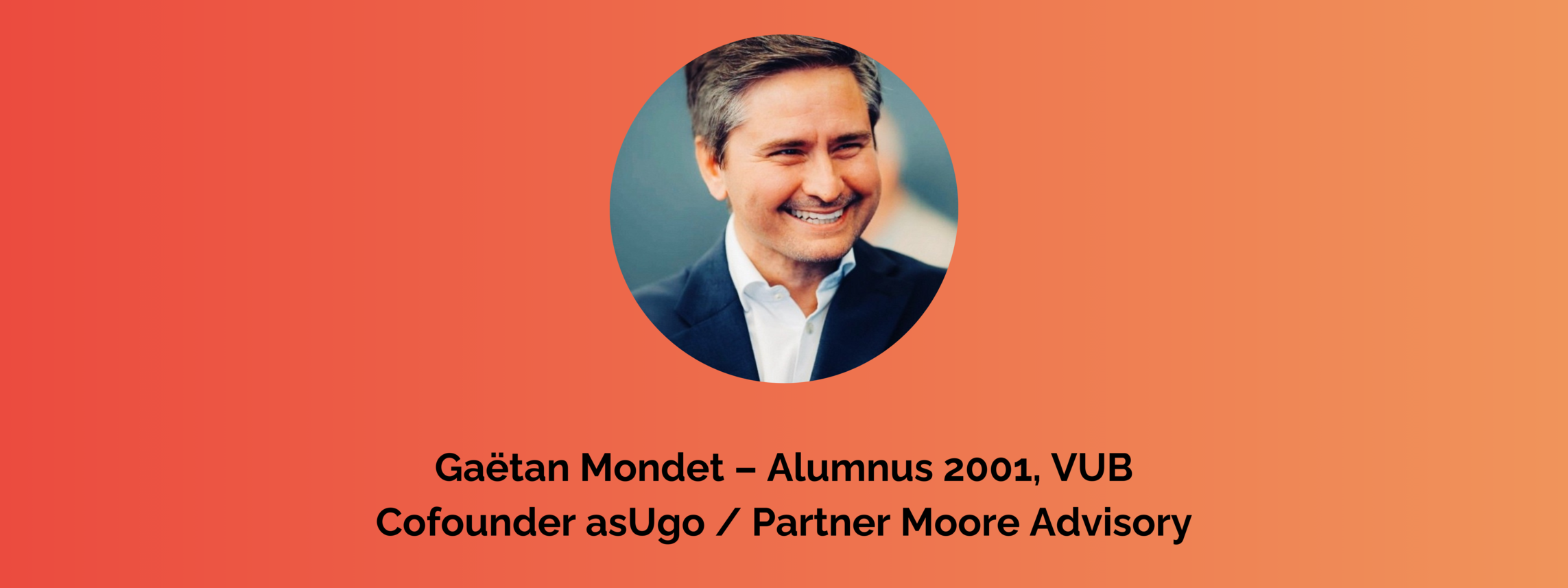
Meet Gaëtan - December 2025.
Published on December 17, 2025
What memories do you keep from your studies at the Solvay Schools?
G: Two memories come back to me immediately.
The first is my student baptism in October 1996 - quite some time ago! It left a strong impression on me because it was truly a leap into the unknown. We were all there together, the “bleus”, and that’s where I made friends for life. This experience brought us incredibly close, in a spirit of total camaraderie. Those who are now among my best friends were baptised alongside me. That baptism also marked the beginning of my years of folklore and student fraternity life - moments I deeply cherished.
The second standout memory is the commercial mission organized at the time (which still exists today under the guidance of Professor Michael Dooms). The mission I took part in took place in Buenos Aires in 2001, during my final year. I had the opportunity to represent a Belgian company active in port engineering and to carry out an on-site market analysis. Ten of us from VUB participated in the project.
For me, this experience symbolised an openness to the world: creating impact, discovering another language, travelling… It was simply amazing. It made a lasting mark on me and perfectly embodied the university’s core values: global openness and human dimension.
How did your time at the Solvay Schools influence your approach to digital and innovation in your current career?
G: To put it simply and concisely, two ideas immediately come to mind: curiosity and critical thinking, along with the notion of being a “student for life” - constantly learning and striving to improve. Everything changes so fast today that it’s essential to work on becoming the best version of oneself, grounded in a scientific mindset. This constant curiosity is part of who I am, and I value it greatly.
Critical thinking is also fundamental, particularly in the face of artificial intelligence: it’s important, for example, to remain alert and aware of the risks of “hallucinations”, which is a very real concern today. Continuous learning, staying open and critical - that’s truly the foundation. For me, it’s crucial because my work is deeply rooted in technology, and technology should serve people and the business, not the other way around. “What’s the business problem you’re trying to solve in the end?”
Finally, I want to highlight the entrepreneurial aspect. We had mini-companies, the commercial mission, and a strong entrepreneurial mindset. In my view, we are entrepreneurs first, before we are managers. This perspective later enabled me to create companies, to work in the Big Four, to grow as an executive in the energy sector, and in a way, to explore several careers at once.
What aspects of your Solvay Schools experience best prepared you for your current challenges?
G: For me, more than the courses, what truly mattered was student fraternity life and student life. I often use the expression: “cleaning the room after the party.” There were always those who would go home to sleep at 1 a.m., and those who stayed to clean the room after the student night or manage the cash register at 3 or 4 a.m. This sense of community, of staying until the end, of honouring commitments - “Do what you say, say what you do” - is a mindset I deeply appreciate.
But this experience went far beyond organising a party. You had to manage a budget, coordinate a team, reconcile different opinions, organise events, find sponsors… You had to hustle, be creative, and learn to accept mistakes - because nothing teaches better than a mistake, especially in a somewhat protected environment.
I truly enjoyed this logic of student fraternity life, including interactions with other fraternities. Yes, there was folklore, but there was also a real mindset that helped me tremendously during my studies. The idea of mini-companies, creating a business plan, building a project and delivering it, confronting the market, working as a team, and collaborating closely with professors and assistants left a strong impression on me. I was also president of Inisol, the student fraternity for final-year students, which gave me the opportunity to manage a fraternity differently and take on more responsibilities.
Finally, internships were essential to put theory into practice. All of this, combined with critical thinking and the university’s values - not blindly accepting everything, maintaining a slightly rebellious spirit typical of ULB and VUB, and upholding humanistic principles - profoundly shaped my view of work and professional life.
What feelings does the Alumni community inspire in you today? Does it play a role in your professional journey?
G: I would say both yes and no. At that age - between 17 and 23 - you live five intense years, but of course many other experiences shape you afterwards. Personally, I am a different person today than I was 25 years ago.
Within the community, what truly matters to me are the people I met at university. They represent a valuable network, rooted in what I call an unconditional bond. It also opens up new perspectives within the wider alumni community.
I’ve travelled and lived abroad quite a lot (in Rome, Paris, Lisbon, Montreal, Toronto and Budapest), and every time I come across an alumnus there, or get in touch, they are always open to conversation - always ready to give a hand. I believe there is real potential to further strengthen this international alumni spirit.
G: Two memories come back to me immediately.
The first is my student baptism in October 1996 - quite some time ago! It left a strong impression on me because it was truly a leap into the unknown. We were all there together, the “bleus”, and that’s where I made friends for life. This experience brought us incredibly close, in a spirit of total camaraderie. Those who are now among my best friends were baptised alongside me. That baptism also marked the beginning of my years of folklore and student fraternity life - moments I deeply cherished.
The second standout memory is the commercial mission organized at the time (which still exists today under the guidance of Professor Michael Dooms). The mission I took part in took place in Buenos Aires in 2001, during my final year. I had the opportunity to represent a Belgian company active in port engineering and to carry out an on-site market analysis. Ten of us from VUB participated in the project.
For me, this experience symbolised an openness to the world: creating impact, discovering another language, travelling… It was simply amazing. It made a lasting mark on me and perfectly embodied the university’s core values: global openness and human dimension.
How did your time at the Solvay Schools influence your approach to digital and innovation in your current career?
G: To put it simply and concisely, two ideas immediately come to mind: curiosity and critical thinking, along with the notion of being a “student for life” - constantly learning and striving to improve. Everything changes so fast today that it’s essential to work on becoming the best version of oneself, grounded in a scientific mindset. This constant curiosity is part of who I am, and I value it greatly.
Critical thinking is also fundamental, particularly in the face of artificial intelligence: it’s important, for example, to remain alert and aware of the risks of “hallucinations”, which is a very real concern today. Continuous learning, staying open and critical - that’s truly the foundation. For me, it’s crucial because my work is deeply rooted in technology, and technology should serve people and the business, not the other way around. “What’s the business problem you’re trying to solve in the end?”
Finally, I want to highlight the entrepreneurial aspect. We had mini-companies, the commercial mission, and a strong entrepreneurial mindset. In my view, we are entrepreneurs first, before we are managers. This perspective later enabled me to create companies, to work in the Big Four, to grow as an executive in the energy sector, and in a way, to explore several careers at once.
What aspects of your Solvay Schools experience best prepared you for your current challenges?
G: For me, more than the courses, what truly mattered was student fraternity life and student life. I often use the expression: “cleaning the room after the party.” There were always those who would go home to sleep at 1 a.m., and those who stayed to clean the room after the student night or manage the cash register at 3 or 4 a.m. This sense of community, of staying until the end, of honouring commitments - “Do what you say, say what you do” - is a mindset I deeply appreciate.
But this experience went far beyond organising a party. You had to manage a budget, coordinate a team, reconcile different opinions, organise events, find sponsors… You had to hustle, be creative, and learn to accept mistakes - because nothing teaches better than a mistake, especially in a somewhat protected environment.
I truly enjoyed this logic of student fraternity life, including interactions with other fraternities. Yes, there was folklore, but there was also a real mindset that helped me tremendously during my studies. The idea of mini-companies, creating a business plan, building a project and delivering it, confronting the market, working as a team, and collaborating closely with professors and assistants left a strong impression on me. I was also president of Inisol, the student fraternity for final-year students, which gave me the opportunity to manage a fraternity differently and take on more responsibilities.
Finally, internships were essential to put theory into practice. All of this, combined with critical thinking and the university’s values - not blindly accepting everything, maintaining a slightly rebellious spirit typical of ULB and VUB, and upholding humanistic principles - profoundly shaped my view of work and professional life.
What feelings does the Alumni community inspire in you today? Does it play a role in your professional journey?
G: I would say both yes and no. At that age - between 17 and 23 - you live five intense years, but of course many other experiences shape you afterwards. Personally, I am a different person today than I was 25 years ago.
Within the community, what truly matters to me are the people I met at university. They represent a valuable network, rooted in what I call an unconditional bond. It also opens up new perspectives within the wider alumni community.
I’ve travelled and lived abroad quite a lot (in Rome, Paris, Lisbon, Montreal, Toronto and Budapest), and every time I come across an alumnus there, or get in touch, they are always open to conversation - always ready to give a hand. I believe there is real potential to further strengthen this international alumni spirit.