

Meet Céline & Arnaud, both from Intermarché - November 2025
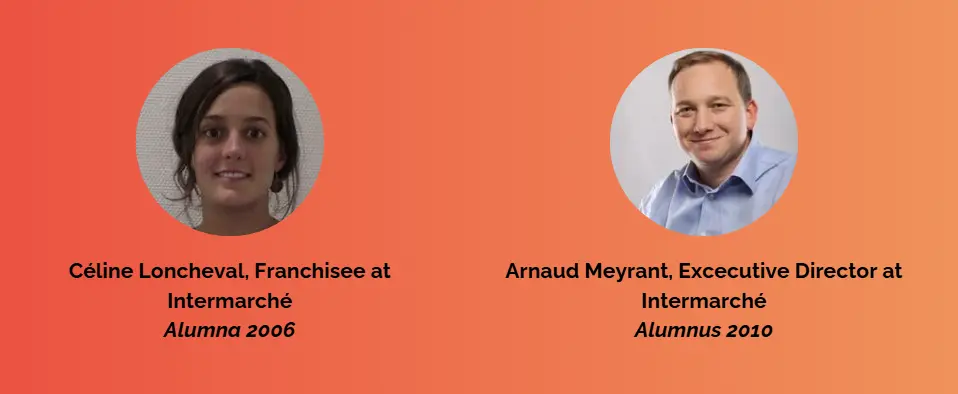
What memories do you have of your studies at the Solvay Schools?
C: A lot of things come to mind, but there is something more general that ultimately guided my career afterward: the “jack-of-all-trades” aspect. The diversity of courses, the fact that the program remains very broad… it truly opens your eyes to a wide range of different topics, and that’s why I chose those studies in the first place. I didn’t want to lock myself into a single field.
Besides that, at the time, we had mandatory Erasmus (keeping in mind that I graduated from Solvay 20 years ago). While today studying abroad seems obvious to everyone, back then – if you can put it that way – the fact that Erasmus was compulsory was quite a bold decision. I went to Poland, which wasn’t the most popular destination for tourism (certainly not at the time). This positive memory of being “required” to go on Erasmus really stands out.
As for the rest, I had a lot of fun: the Solvay student circle, I was a bit involved in the social committee… it’s a very strong community. I remember going to Central Station to hand out soup: a great memory.
A: First of all, I would say my involvement in student life. I was very active in the student circle, in various committees, and I served as vice-president of the circle. That definitely left a strong mark on my time at the Solvay Schools.
It also allowed me to get a first taste of the realities of the corporate world, particularly through organizing events within the committees. The economic and operational reality of these events provided an early “reality check” on how to manage an organization—almost like running a small business. It is a very vivid memory, one that also created lasting friendships. These relationships still exist today and remain among my strongest memories.
Academically, the program offered a broad introduction to the world and to business life. A particularly striking example: we had a course on monetary theory with our professor right in the middle of the subprime crisis. Classes were held at the end of the day, and the professor often came straight from ministerial meetings or consultations with leaders of the country’s banking and financial institutions who were dealing with the crisis. So we were learning pure monetary theory, but it directly connected with what we saw on the news that same day, the day before, or the day after. That’s when you realize that what you are studying is a living subject, constantly evolving.
Finally, Erasmus and the exposure to internationally diverse professors during the master’s courses immersed us in a variety of cultures and in different ways of managing companies: in Belgium, where management culture was more traditional at the time, and in other countries where business approaches were sometimes more innovative.
In which sector were you working before joining Intermarché?
C: I was working at Sybelga, in the energy sector. A very different industry, but one that is highly talked about at the moment, and in full transition. It was really very interesting.
A: My career has unfolded in three stages: I started at Deloitte as a consultant, focusing on corporate strategy. Then I joined the Louis Delhaize Group, a family-owned holding company active in retail, in a role more oriented toward strategy, business transformation, and M&A.
Today, since last April, I have been serving as Executive Director of Intermarché Belgium, with a role strongly focused on operational management, development, and transformation.
What made you decide to join Intermarché?
C: As I mentioned, the energy sector is fascinating and ultimately affects everyone, all consumers. But I felt that I was starting to box myself into a specialization and into an expert role, which I absolutely did not want for the rest of my career. This ties back to what I mentioned earlier: I chose Solvay because of its generalist approach, which allows you to touch on everything without limiting yourself.
Covid also played an important role in my decision to change direction, to do something else, to move towards a sector that touches people even more directly. And naturally, mass retail came to mind: everyone is a consumer. I wanted to reconnect with the truly “real” economy. I started exploring options at that time together with my husband, who worked in the finance sector. You could say we had the same realizations at the same moment: that’s when the seed started to grow. The retail sector attracted both of us.
Why Intermarché? It’s perhaps a somewhat atypical cooperative, in the sense that the franchisor and franchisee roles truly belong to the same structure. There is a real interdependence and a strong specificity: every member works a “third-time” (internal term) for the central organization, contributing their time and skills to make the Intermarché central office operate. It benefits everyone. There is no barrier between franchisor and franchisee: we work hand in hand. We are both members and upstream actors. This unique aspect appealed to us and, after a few meetings, we were convinced.
A: Intermarché is an extremely dynamic company, with major challenges related to growth and corporate transformation, especially internally, to support this expansion.
The food retail market in Belgium is also very dynamic, even under pressure, with numerous market movements, consolidation, new entrants, and evolving food consumption patterns. It is a sector that has always attracted me.
Intermarché has a rather unique positioning: it is a company co-managed by its members, which brings a strong field-driven logic to decision-making. On top of that, there are significant transformation challenges, which for a profile like mine represent the ideal challenge.
Did your studies at Solvay guide you toward this career change/evolution?
C: Oh yes, absolutely. Being able to touch on everything, not locking myself into a single field, being versatile, multitasking… that’s really what I enjoy. And here, clearly, every day goes in all directions.
You have to manage the store floor, everything commercial, financial, social aspects (HR, payroll…). We’re no longer in a large corporation where you can climb the ladder and evolve over time. In our sector, it’s really not that simple: it’s not a pyramidal structure like in many big companies. So you also have to know how to manage people, their expectations, their desire to grow, etc.
It covers an incredibly wide field, and that is exactly what I love.
A: Yes, clearly. The studies at the Solvay Schools provide a fairly generalist foundation, enabling you to address a wide variety of topics. Today, in a general management role, this helps tremendously in tackling diverse and complex issues.
These issues can be human, financial, technical, logistical, or commercial in nature. The skillset acquired at Solvay is therefore extremely valuable for dealing with such varied challenges while defining and following a strategic trajectory.
What feelings does the Alumni community inspire in you today?
C: I must say, I’m not very involved in it. Except for the fact that I’ve stayed very close to certain people from my class, who are still friends today.
But I have to say that throughout my career, whenever I come across former Solvay students (whether I know them well or not at all), it immediately breaks the ice. We share a similar background, we lived through similar things, the same stages…
It remains a strong feeling. I don’t know if it’s tied to the studies themselves, but there is a common way of functioning. That’s how I feel it, and I noticed it in other companies where I worked. It’s hard to explain, but there really is that little something we have in common.
A: I would say it’s a goldmine that is not exploited enough.
Overall, I have always been happy to attend the occasional event, and the recent developments in the programming are very positive, but I realize that I haven’t made enough effort to take part regularly. I think this is a shared feeling when I discuss it with other alumni.
The alumni network is a true asset that we could rely on much more as professionals. It represents significant strength.