
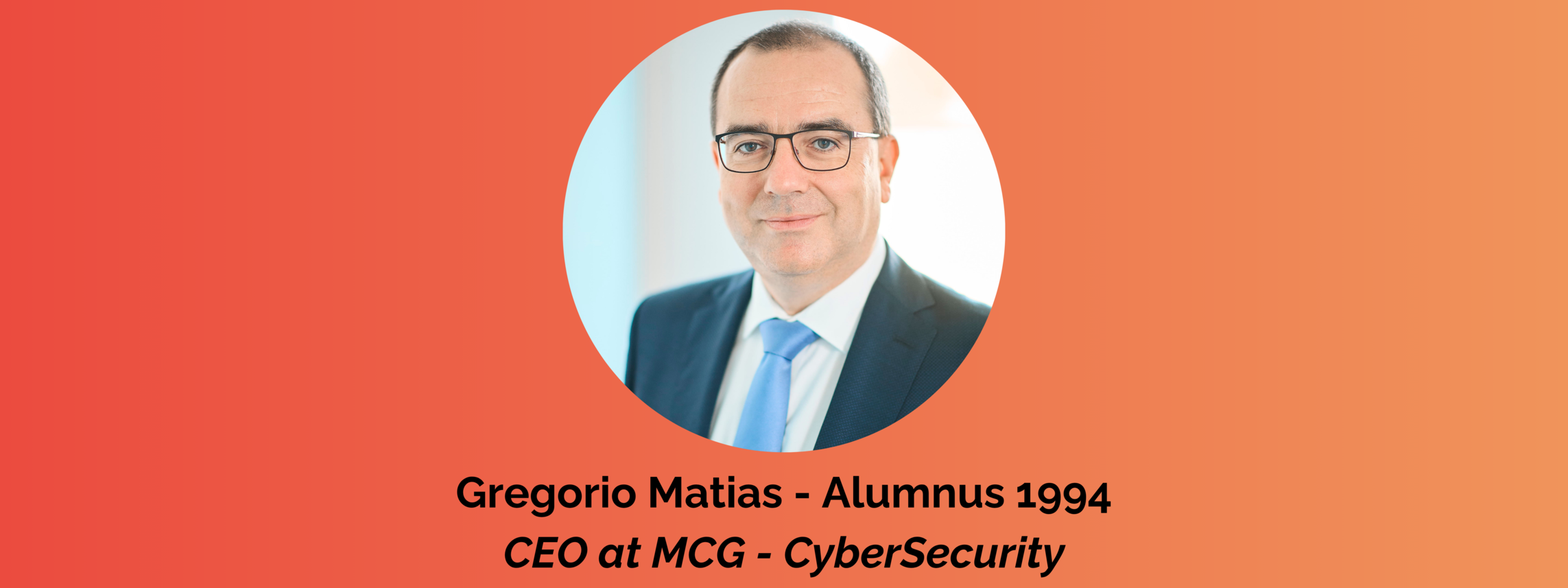
Meet Gregorio - April 2026.
1. What memories do you keep from your studies at Solvay Schools? Could you mention two?
G: I have many memories… and above all, very happy ones.
Among them, two stand out as particularly meaningful:
The Political Economy course in my first year, taught by a legendary professor: Mr. Henri Vander Eycken. That’s where I discovered economics, academic rigor, and learned to develop a critical mindset toward what is published in the media.
The creation of the Student Office for Economics (BESCO) - at the time, we were not yet merged with the Solvay Business School. The goal was clear: to help students with summaries and syntheses, just as GES was doing for the School of Commerce. It was a wonderful adventure in which I served as coordinator.
2. How did your years at Solvay Business School influence your way of working today in the IT sector, a constantly evolving environment?
G: Today, young graduates look for tools they can immediately apply in their professional lives. However, no young professional can assume they will remain in the same career path forever. This is where the knowledge and values provided by our Alma Mater become invaluable assets: scientific rigor, critical thinking combined with an open mind (the spirit of free inquiry), continuous learning, and never resting on one’s achievements… as well as a highly revealing teaching method: case studies.
The latter challenged, unsettled, and sometimes disrupted us… but it reflects real professional life, which every graduate will face - and which I experience every day.
3. What in your experience at Solvay Business School best prepared you for the specific challenges of the IT sector (rapid innovation, digital transformation, international collaboration, etc.)?
G: At the time, IT was still in its early stages… we did not speak about the Internet, cybersecurity, cloud computing, and certainly not generative AI. And yet, the entire learning process enabled me to approach these technological revolutions and disruptions with perspective, a global understanding, and above all, the ability to adapt to continuous waves of innovation that evolve (and will continue to evolve) at a very fast pace.
The ability to reframe these innovations within a global economic context, industrial strategies, and a highly competitive market is truly one of the key skills my studies provided.
4. You are particularly involved in the Solvay Alumni community (e.g., organizing the golf tournament): what does this community represent for you today? What role does it play in your professional and personal journey?
G: Being part of the Alumni network was an obvious path for me from my student years… I was a student representative and coordinator of the student office, so it was only natural that I would continue serving my community within the Alumni network (and I have done so since 1994).
More deeply, the Alumni community represents networking, sharing, and enjoyment… but also the opportunity to provide scholarships to students (such as the Étienne Sadi Kirschen Prize and the Eugène de Barsy Prize for theses) and to support the faculty in developing new educational projects through Alumni contributions.
Just as in the past, I feel useful and proud to be part of this journey.