
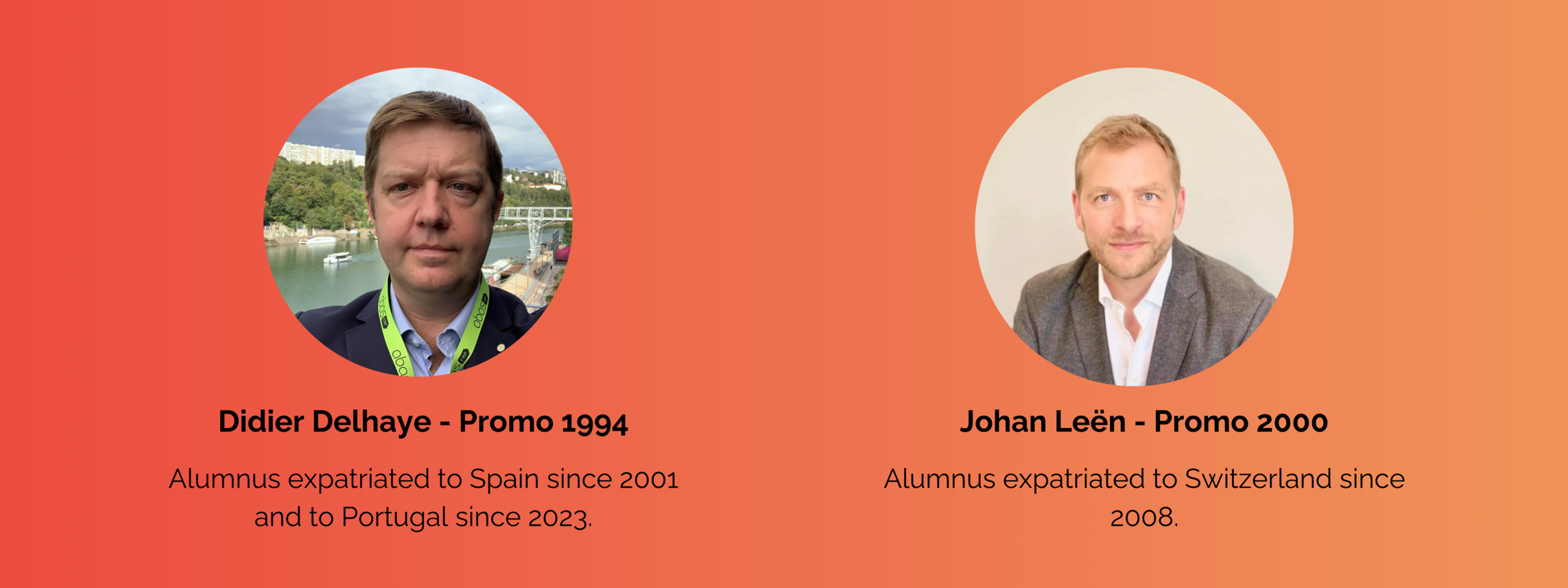
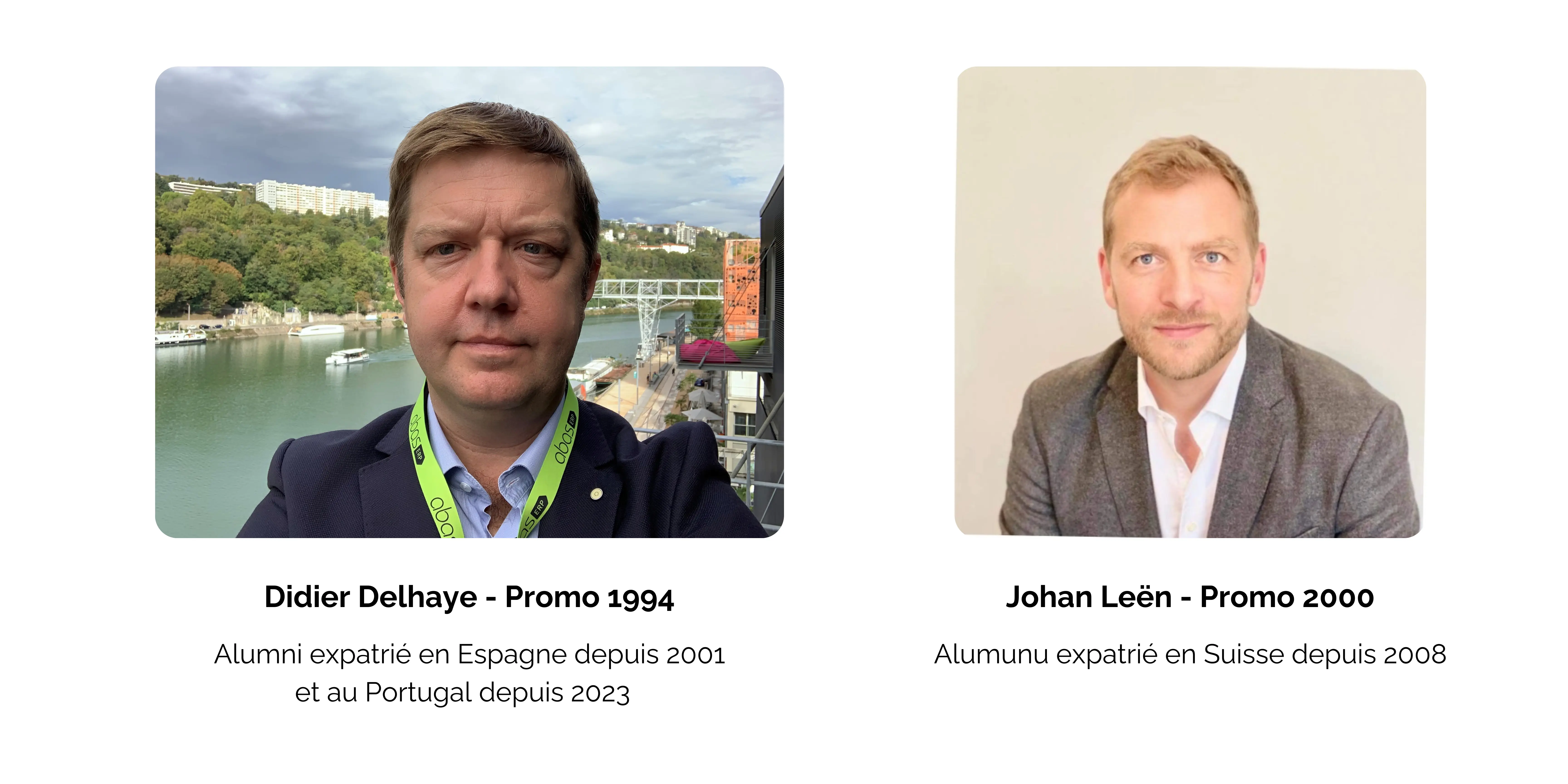
Meet Didier & Johan - September 2025
What memorable experience(s) do you keep from your years at Solvay Schools? Can you mention one or two?
D: The common thread in my memories of Solvay is, above all, the people I met. Some of these encounters had a decisive impact on my professional life.
It has now been nearly 25 years that I have been in business with someone I met on the university benches. More specifically, my encounter with Pierre Baudoin, who became my lifelong business partner: next year, we will celebrate together the 25th anniversary of our first company.
J: The first and last day left a strong impression on me. When you arrive, you are thrown into the deep end quite quickly. And when you finish your last exam, it’s hard to believe it’s over. The rest seems to have flown by. My fondest memories are tied to the friendships I formed at that time, which remain very strong today.
Which event or realization was decisive in your choice to live and work abroad?
D: Right after my studies, I went on a six-month backpacking trip in South America with Pierre Baudoin. This experience truly opened my eyes to the world: I realized that life didn’t stop in Brussels, or even in Belgium. It was a real eye-opener.
Upon my return, I worked for a few years while keeping this desire to go abroad in mind. Then, in 2001, at the time of the Internet boom, I collaborated with former colleagues – some from Solvay (Arnaud Valenduc IC 94) – who had created a start-up. That’s how I joined Pierre Baudoin in Madrid to launch the Spanish branch, with the mission of opening the Spanish and Italian markets.
J: Without a doubt, it was my exchange in Oslo. People often say that travel shapes youth. A better phrase might be that Erasmus shapes youth. Immersing oneself in a new culture and meeting new people gives travel a whole new dimension. Today, I couldn’t imagine living in just one country, while still keeping my roots close, as I spend a lot of time in Belgium.
How did your training at Solvay prepare or help you to evolve in an international environment? If so, how?
D: Yes, absolutely. The training at Solvay is relatively versatile in business. You touch on everything: marketing, accounting, finance… This diversity gave me a solid foundation that still serves me today.
This versatility allowed me to adapt to very different contexts and environments. In addition, my first experiences in banking and consulting provided the necessary foundation to build my first company.
J: The Erasmus program was probably the most international aspect of the curriculum in the 1990s. Today, with programs offered in English, double or triple degrees, and the development of exchange programs, internationalization is everywhere.
Beyond these obvious aspects, Solvay has always aimed to prepare its students to face contemporary challenges, fostering curiosity, developing rigor and agility, and offering numerous international opportunities. I would even argue that in our school’s DNA, there is a strong “adventurer’s gene,” which pushes many of us to pursue entrepreneurial careers or international paths.
What advice would you give to young Solvay graduates who dream of an international career?
D: In life, you should always pursue your dreams. And the earlier, the better. Today, with programs like Erasmus, opportunities are plentiful: anyone who wants to go international should do it quickly.
You have to dare to take risks when you are young, because you have less to lose. Later, with children, expenses, or a mortgage, it becomes more complicated. And at worst, you can always come back. Better to have regrets than remorse.
My message is simple: live, don’t hesitate, take the leap as early as possible, before you become too tied down by private commitments.
J: The world is your playground. And at the speed the world is evolving, the Moon or Mars could soon be part of it. More seriously, our education helps us continuously push boundaries. You have to dare to go after them, to pursue your dreams and ambitions to the fullest.
Is there a large Solvay alumni community in your area? Do you know if initiatives or a network similar to the “Ambassador” program already exist there?
D: In the coming weeks, we should organize a first meeting in Lisbon. Stay tuned!
I have always been someone who values networking, and it has helped me a lot in my professional journey. When I arrived in Spain in 2001, and more recently in Portugal in 2023, my first initiative was to contact former classmates (including two graduates from 1992, whom I warmly thank, Bertrand Caudron and Marc Dugimont). They gave me excellent advice and guided my choices, which was fundamental.
The idea is to list alumni living in Portugal and Spain, then organize two to three meetings per year to connect people. This network can be a real tool, both for newcomers seeking guidance and for those already established, whether to find partners, develop business, or even launch a company.
From the information I have, the community includes around 30 people in Portugal and 50 to 60 in Spain. It includes several profiles:
- those who have lived here for a long time (10 to 15 years),
- those who come to work temporarily,
- and those who invest, notably because they own a vacation home.
J: There are approximately 450 Solvay alumni in Switzerland. Several attempts have been made to bring them together in one way or another, but none have lasted so far, unfortunately. This is certainly a project to work on in the coming years.
The latest initiative is Solvay’s integration into Asage in Switzerland (http://asage.ch), an association that brings together alumni from the Grandes Écoles. This allows us to connect with our peers in often exceptional settings, always in a friendly atmosphere, and to increase our visibility in Switzerland.